Note
Go to the end to download the full example code.
Integration Rules#
This example is intended to showcase how integration rules work. There are currently two supported rules:
"gauss", which is uses Gaussian quadrature,"gauss-lobatto", which is uses Gaussian-Lobbato-Legendre nodes for quadrature.
import numpy as np
from fdg import IntegrationMethod, IntegrationSpecs
from matplotlib import pyplot as plt
Different Types of Integration Rules#
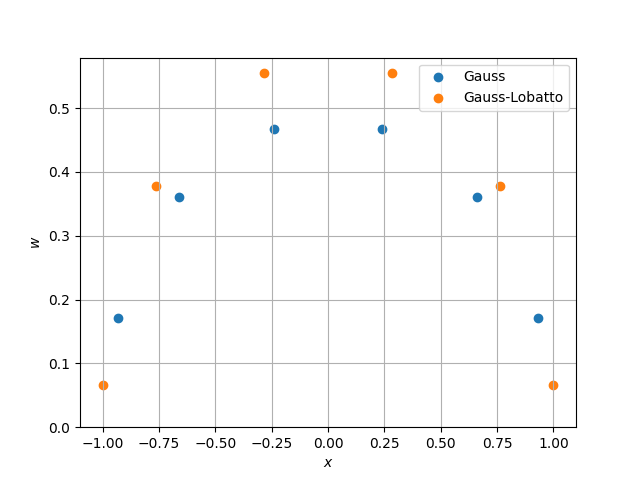
There are different types of integration rules. The first one is the Gaussian quadrature, which is accurate up to the integrals of order \(2n - 1\) for a rule of order \(n\). The second one is the Gauss-Lobatto quadrature, which also includes the endpoints of the domain, which makes it useful for some cases, but it reduces the accuracy of integration to order \(2n - 3\) for a rule of order \(n\).
rule_gauss = IntegrationSpecs(5, IntegrationMethod.GAUSS)
rule_gl = IntegrationSpecs(5, IntegrationMethod.GAUSS_LOBATTO)

fig, ax = plt.subplots()
ax.scatter(rule_gauss.nodes(), rule_gauss.weights(), label="Gauss")
ax.scatter(rule_gl.nodes(), rule_gl.weights(), label="Gauss-Lobatto")
ax.grid()
ax.legend()
ax.set_ylim(0)
ax.set(xlabel="$x$", ylabel="$w$")
plt.show()
Integrating Polynomials#
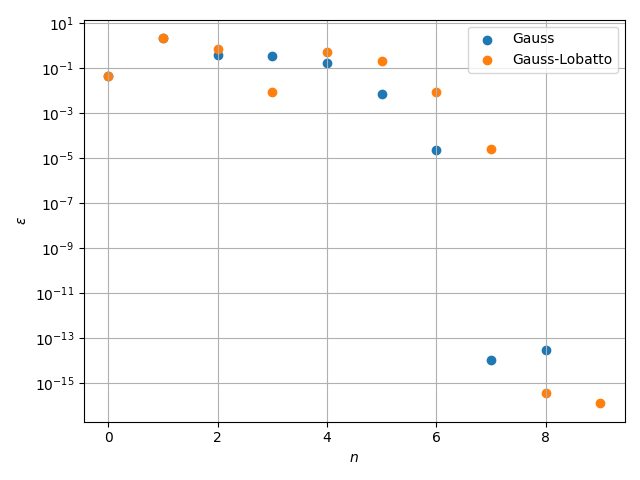
Polynomials are exactly integrated up to the degree which is given by the IntegrationRule.accuracy property. The error decreases exponentially as that order is approached.
rng = np.random.default_rng(seed=0)  # Make rng predictable
N_POLY = 14
coeffs = rng.uniform(0, 1, size=N_POLY + 1)
poly = np.polynomial.Legendre(coeffs, domain=(-1, +1))
Using Gaussian Quadrature#
gauss_integral_values: list[float] = list()

gauss_order = 0
while True:
    rule = IntegrationSpecs(gauss_order, IntegrationMethod.GAUSS)
    value = np.dot(rule.weights(), poly((rule.nodes() - 1) / 2)) / 2
    gauss_integral_values.append(value)
    if rule.accuracy >= N_POLY + 2:
        # Go one further
        break
    gauss_order += 1
Using Gaussian-Lobatto Quadrature#
gauss_lobatto_integral_values: list[float] = list()

gauss_lobatto_order = 0
while True:
    rule = IntegrationSpecs(gauss_lobatto_order, IntegrationMethod.GAUSS_LOBATTO)
    value = np.dot(rule.weights(), poly((rule.nodes() - 1) / 2)) / 2
    gauss_lobatto_integral_values.append(value)
    if rule.accuracy >= N_POLY + 2:
        # Go one further
        break
    gauss_lobatto_order += 1


fig, ax = plt.subplots()

ax.scatter(
    np.arange(gauss_order),
    np.abs(
        (np.array(gauss_integral_values[:-1]) - gauss_integral_values[-1])
        / gauss_integral_values[-1]
    ),
    label="Gauss",
)
ax.scatter(
    np.arange(gauss_lobatto_order),
    np.abs(
        (np.array(gauss_lobatto_integral_values[:-1]) - gauss_lobatto_integral_values[-1])
        / gauss_lobatto_integral_values[-1]
    ),
    label="Gauss-Lobatto",
)
ax.set(yscale="log", xlabel="$n$", ylabel="$\\epsilon$")
ax.grid()
ax.legend()
fig.tight_layout()
plt.show()
Total running time of the script: (0 minutes 0.283 seconds)